
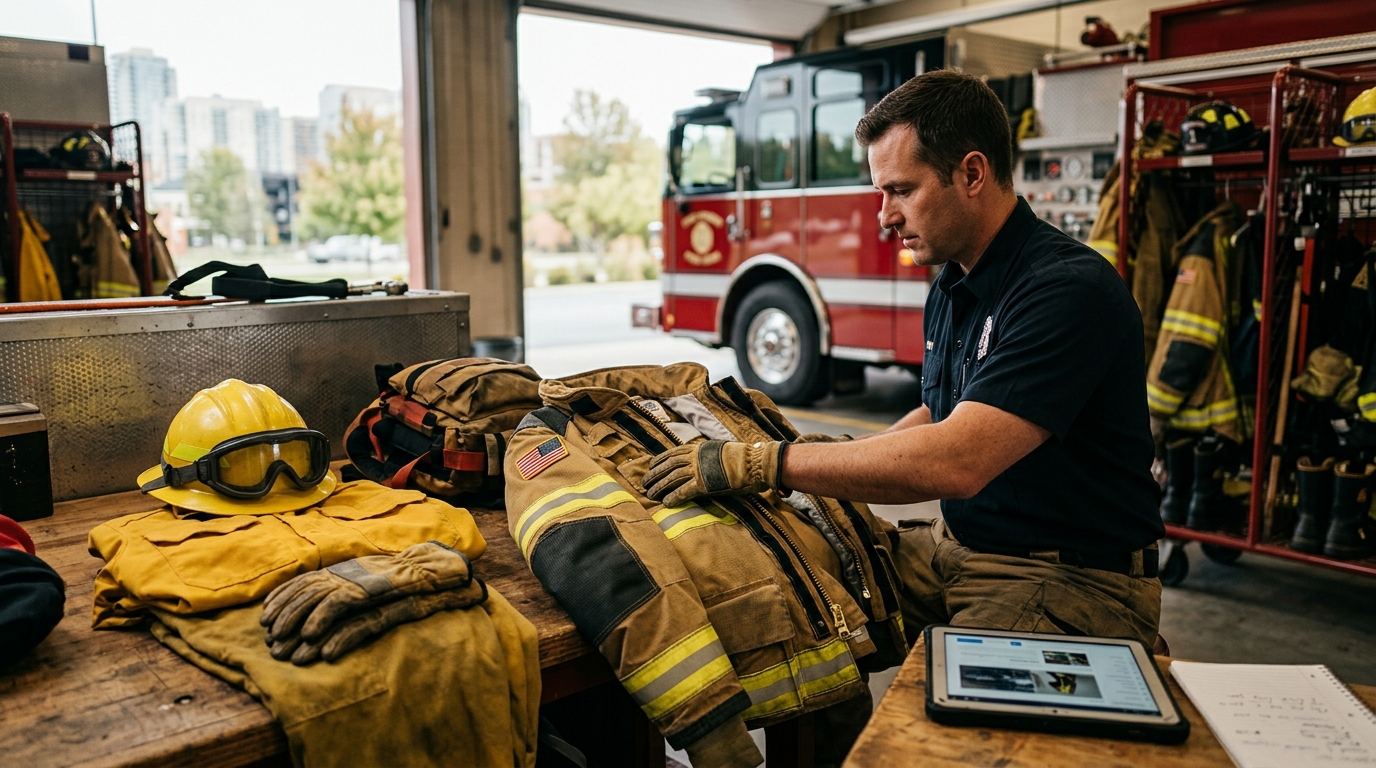
Structural Fire Gear & Wildland Kits Online: Comparing What Matters in an NFPA-Compliant Supplier
Firefighters shopping for protective equipment online face a unique challenge: balancing certification compliance, turnaround speed, customization options, and budget—all without the luxury of trying gear on at a brick-and-mortar showroom. This comparison post breaks down the critical evaluation criteria side by side so you can confidently choose the right online source for both structural turnout gear and wildland PPE kits.
The Standards Landscape: NFPA 1970, 1971 & 1977
Before comparing suppliers, you need to know which certifications to verify on every purchase order.
Structural Gear — NFPA 1971 → NFPA 1970
NFPA 1971 has long been the benchmark for structural firefighting PPE. It defines minimum design, performance, testing, and certification requirements for turnout coats, pants, helmets, hoods, gloves, and boots. In 2024, the NFPA consolidated four separate standards—1971, 1975, 1981, and 1982—into a single document: NFPA 1970. This consolidated standard became effective in late September 2024, and existing turnout clothing products must be re-certified to the new requirements by September 2025.
Key changes in NFPA 1970 include making particulate-blocking hoods mandatory rather than optional, introducing PFAS restrictions backed by improved testing methods, and adding new criteria for rating SCBA electronics in explosive environments.
Wildland & WUI Gear — NFPA 1977
NFPA 1977 addresses an entirely different operational profile. The standard was created to combat heat stress in wildland firefighting after findings in 1989 showed the majority of wildland firefighter injuries were related to overheating rather than direct flame contact. It specifies minimum requirements for protective garments, helmets, gloves, footwear, goggles, chainsaw protectors, and load-carrying equipment. The 2022 edition added urban interface firefighting protective clothing to its scope.
Two quantitative metrics define NFPA 1977 fabric quality: Radiant Protective Performance (RPP), which must be at least 7, and Total Heat Loss (THL), which ensures breathability during prolonged exertion.
Five Criteria for Comparing Online Fire Gear Suppliers
Use this framework to evaluate any retailer before placing an order.
| Criterion | What to Verify | Red Flag |
|---|---|---|
| Certification Transparency | Product pages list exact NFPA edition (e.g., 1971-2018 or 1970-2025) and third-party certification body | Vague claims like “meets NFPA standards” with no edition or lab cited |
| Customization Workflow | Online configurator for shell fabric, moisture barrier, thermal liner, trim, and lettering | No measurement guide or size chart; no option to specify fabric composite |
| Lead Time & Fulfillment | Stated production window with tracking; ideally 8–12 weeks for custom turnout gear | No estimated delivery date; fulfillment exceeds 20 weeks with no updates |
| Post-Sale Support | Guidance on NFPA 1851 care and maintenance; warranty details; alteration services | No mention of inspection schedules, cleaning protocols, or retirement timelines |
| Wildland Kit Bundling | Pre-assembled kits that pair NFPA 1977 garments with compliant helmets, gloves, and boots | Wildland items sold piecemeal with no cross-reference to NFPA 1977 certification |
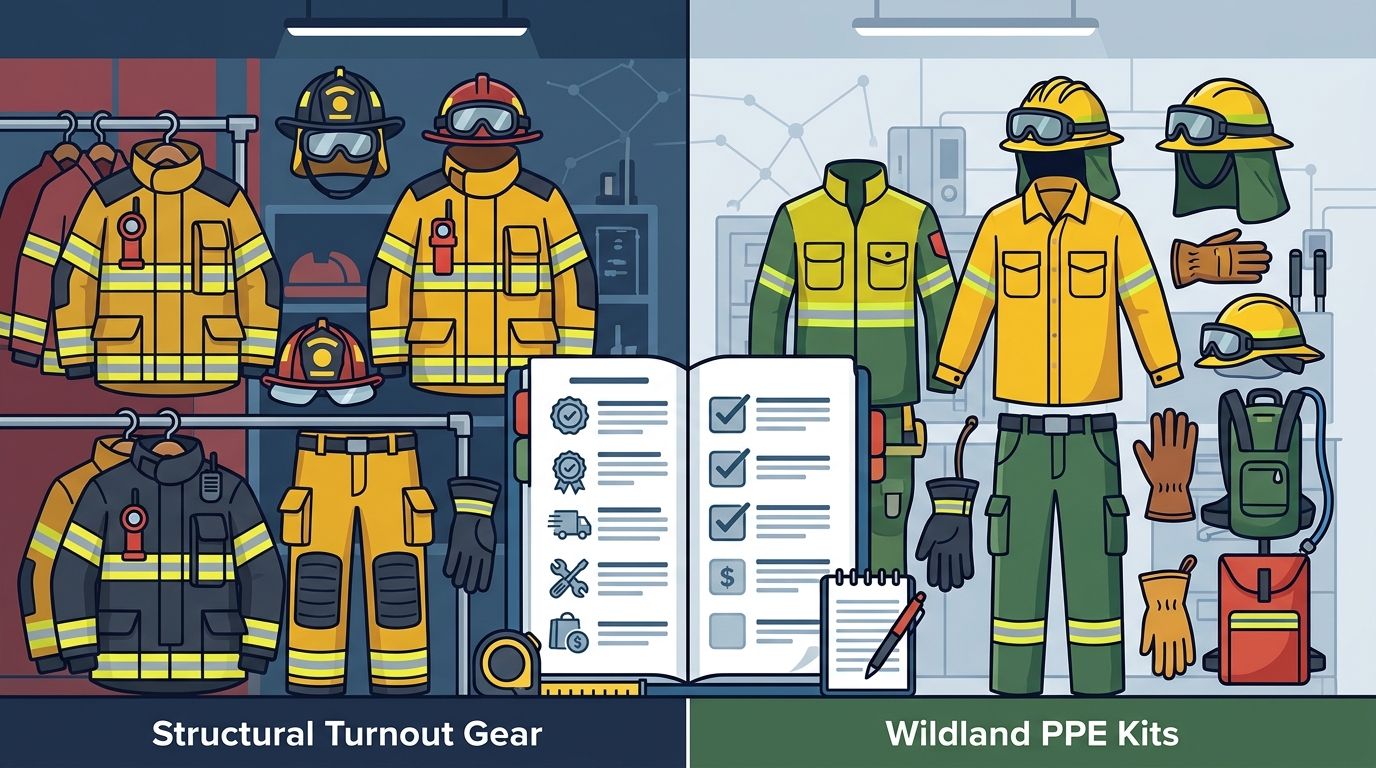
Structural Turnout Gear: What Separates the Best Online Options
Fabric Composite Performance
Every turnout gear composite consists of three layers: the outer shell, the moisture barrier, and the thermal liner. Together these layers are tested for TPP (Thermal Protective Performance) and THL (Total Heat Loss). The NFPA minimum TPP score is 35, which translates to roughly 17.5 seconds of protection before a second-degree burn in a flashover simulation. THL measures the ability of the composite to let body heat and vapor escape—a critical metric given that overexertion and heat stress remain the number-one cause of on-duty firefighter deaths.
When ordering online, look for suppliers that publish the TPP and THL values for every composite option, not just the shell fabric brand name.
PFAS-Free Gear Considerations
The transition to PFAS-free moisture barriers is one of the most significant changes in recent PPE history. NFPA 1970-2025 includes new testing methods and material restrictions around PFAS. However, some performance thresholds for liquid penetration, durability, and breathability were reduced alongside the PFAS restrictions, meaning departments should request full performance data sheets—not just a certification label—to understand exactly what protection level their new gear provides.
Why Chief Miller Apparel Stands Out for Structural Gear
Chief Miller Apparel is a firefighter-owned online retailer that combines decades of frontline experience with a curated product catalog. The store launched Ricochet turnout gear—an American-made brand manufactured in Philadelphia—for direct online ordering. Customers select fabrics, colors, and configuration options, submit their measurements, and place the order through chiefmillerapparel.com. The stated turnaround is 8–12 weeks, which is notably fast for custom-built structural gear.
Beyond turnout ensembles, Chief Miller stocks structural firefighting gloves (including the NFPA-certified MK-1), helmets like the Pacific F18H Haloflex, particulate-blocking hoods, forestry hose packs, and a broad range of rescue tools—making it possible to outfit a crew from a single source.
Wildland PPE Kits: Key Differences from Structural Gear
Using structural turnout gear for wildland operations is dangerous. Structural composites trap too much body heat for the sustained physical labor wildland firefighting demands. NFPA 1977 gear is engineered around single-layer or lightweight multi-layer fabrics—typically Nomex or aramid blends—that balance flame resistance with maximum breathability.
What a Complete Wildland Kit Includes
- Protective garment (shirt and pants): NFPA 1977-certified, often in high-visibility yellow for aerial and ground visibility through smoke.
- Helmet: Wildland-specific (lighter weight, brim style) certified to NFPA 1977.
- Gloves: Leather or aramid blend providing dexterity for hand-tool work.
- Boots: NFPA 1977-compliant with lug soles for steep terrain.
- Goggles: NFPA 1977 or ANSI Z87.1-compliant with helmet attachment.
- Fire shelter: Required by USFS specification for federal wildland assignments.
- Load-carrying equipment: Line packs certified under NFPA 1977.
Some firefighters opt for dual-certified garments that meet both NFPA 1977 and NFPA 1975 (station wear), allowing a seamless transition from the firehouse to the fire line without a gear change.
Chief Miller’s Wildland Inventory
Chief Miller Apparel carries wildland-specific items including brim wildland helmets, forestry hose packs, and an expanding line of wildland PPE accessories. The store’s quote-request system lets departments bundle items into a single purchase order, simplifying procurement for budget-conscious volunteer and career departments alike.
Procurement Checklist: Before You Click “Buy”
- Confirm the NFPA edition. Ask whether gear is certified to NFPA 1970-2025 or the outgoing NFPA 1971-2018 edition. Both may be on the market during the transition window.
- Request performance data. NFPA certification sets minimum thresholds. Many composites exceed these minimums, and suppliers should share test results so you can compare options.
- Verify the certification body. Look for labels from recognized third-party labs such as UL or SEI (Safety Equipment Institute).
- Plan for NFPA 1851 compliance. Selection is only the first step; the standard also governs cleaning, inspection, repair, and retirement of structural gear. Choose a supplier who can advise on the full lifecycle.
- Factor in total cost of ownership. A lower purchase price means little if the composite degrades faster. Evaluate warranty terms, expected service life, and cleaning costs.
- Measure accurately. Online ordering removes the fitting room. Use the supplier’s measurement guide precisely—Chief Miller Apparel’s ordering process walks you through each dimension.
Side-by-Side: Structural vs. Wildland Gear at a Glance
| Feature | Structural (NFPA 1971 / 1970) | Wildland (NFPA 1977) |
|---|---|---|
| Primary hazard | Flashover, radiant heat, steam | Radiant heat, direct flame brush contact, heat stress |
| Layers | Three-layer composite (shell + moisture barrier + thermal liner) | Single-layer or lightweight dual-layer |
| Min TPP | 35 | N/A (uses RPP ≥ 7) |
| Breathability focus | THL rated but secondary to thermal protection | THL is primary design driver |
| Weight | Heavier; limits sustained exertion | Lightweight for extended hiking and digging |
| Typical color | Tan, black, or department-specified | High-visibility yellow (shirt); green or tan (pants) |
Key Takeaways
- NFPA 1970 now consolidates structural PPE standards; confirm which edition your gear is certified to before ordering.
- NFPA 1977 governs wildland and WUI gear with an emphasis on breathability and heat-stress prevention—never substitute structural turnout gear on the wildland line.
- Evaluate online suppliers on certification transparency, customization tools, lead time, post-sale NFPA 1851 support, and wildland kit bundling.
- Chief Miller Apparel offers Ricochet structural turnout gear with an 8–12 week turnaround, plus wildland helmets, forestry packs, and rescue tools—all from a firefighter-owned store at chiefmillerapparel.com.
- Always request TPP, THL, and RPP performance data beyond the certification label, especially as PFAS-free composites enter the market.
Frequently Asked Questions
What NFPA standards apply to structural firefighting gear in 2025?
NFPA 1970, effective September 2024, consolidates the former NFPA 1971, 1975, 1981, and 1982 into one document. All new turnout clothing must be certified to NFPA 1970-2025 by September 2025, though gear already certified to NFPA 1971-2018 remains in service until it reaches retirement criteria under NFPA 1851.
What is NFPA 1977 and who needs it?
NFPA 1977 is the Standard on Protective Clothing and Equipment for Wildland Fire Fighting and Urban Interface Fire Fighting. It covers garments, helmets, gloves, footwear, goggles, chainsaw protectors, and load-carrying equipment. Any firefighter engaged in wildland or WUI operations should be equipped with NFPA 1977-certified PPE.
Can I order custom structural turnout gear online?
Yes. Chief Miller Apparel offers Ricochet turnout gear through an online ordering process where you select fabrics, colors, options, and sizes. Custom orders ship in roughly 8–12 weeks—significantly faster than many traditional distribution channels.
Why should I care about PFAS in fire gear?
PFAS compounds have been commonly used in moisture barriers. NFPA 1970-2025 introduces restrictions and new testing methods for these substances. Non-PFAS alternatives may have different liquid penetration and breathability characteristics, so it is important to review full performance data rather than relying solely on the certification label.
What is the difference between TPP and THL ratings?
TPP measures how long a fabric composite protects against a second-degree burn during a flashover simulation; the NFPA structural minimum is 35. THL measures how effectively the composite releases body heat and moisture vapor. Both metrics matter, but THL is especially critical for wildland operations where heat stress is the leading cause of injury.
Does Chief Miller Apparel carry wildland gear?
Yes. Chief Miller stocks wildland helmets, forestry hose packs, wildland PPE accessories, and offers a quote-request system for departments that want to bundle multiple items into one purchase order.