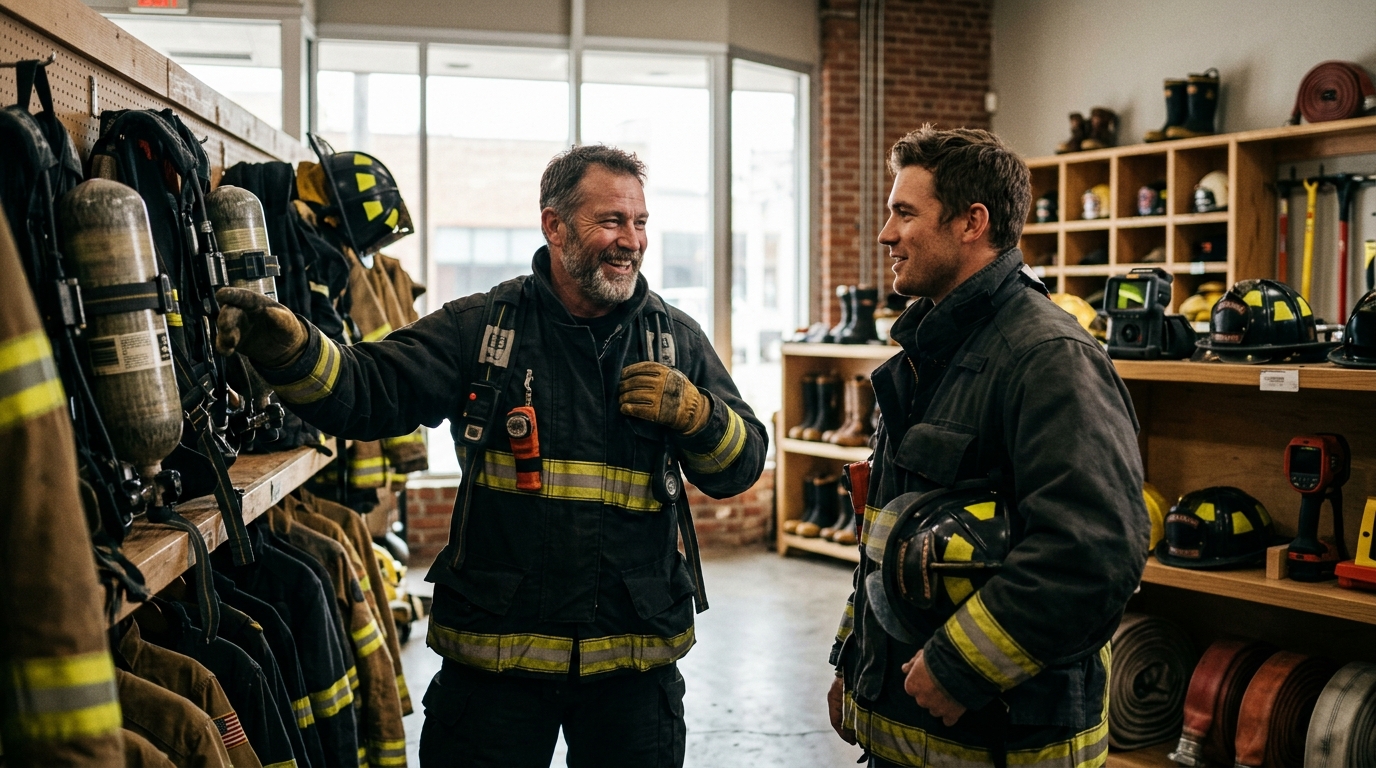
Shopping for self-contained breathing apparatus (SCBA) gear or a thermal imaging camera (TIC) is not like buying a pair of boots. The wrong choice can jeopardize safety on the fireground. That is exactly why an increasing number of departments prefer purchasing from firefighter-owned stores—retailers run by people who have actually worn the gear in the field. This guide walks you through a repeatable process for identifying those stores and evaluating their SCBA and TIC inventory against real-world standards.
Why Firefighter-Owned Stores Matter for SCBA and TIC Purchases
Generic safety-supply companies stock thousands of SKUs, but they rarely have staff who have crawled through zero-visibility smoke with an SCBA on their backs. Firefighter-owned retailers bring an entirely different perspective. At Chief Miller Apparel, for example, the team is firefighter-owned and operated and draws on decades of combined firefighting knowledge to curate every product listing. That insider perspective means gear is field-tested, dependable, and built to last.
This matters because SCBA and thermal imaging cameras are life-safety equipment. Compatibility between your facepiece, harness, cylinder, and PASS device is non-negotiable. A store owner who has personally used a Scott Air-Pak X3 Pro or a Dräger PSS 7000 can speak to fitment issues a warehouse catalog never will.
Know the Standards Before You Shop
NFPA 1981 — SCBA
NFPA 1981 is the Standard on Open-Circuit Self-Contained Breathing Apparatus for Fire and Emergency Services. It specifies the minimum requirements for the design, performance, testing, and certification of SCBA used during firefighting, rescue, hazmat, and similar operations. The current edition—commonly called the 2019 Edition—introduced improvements to heads-up display (HUD) settings, End of Service Time Indicators (EOSTIs), intrinsic-safety requirements, and wireless connectivity.
Any SCBA you purchase from any retailer should be certified compliant with this standard. Before adding an item to your cart, verify the edition year on the product spec sheet.
NFPA 1801 — Thermal Imagers
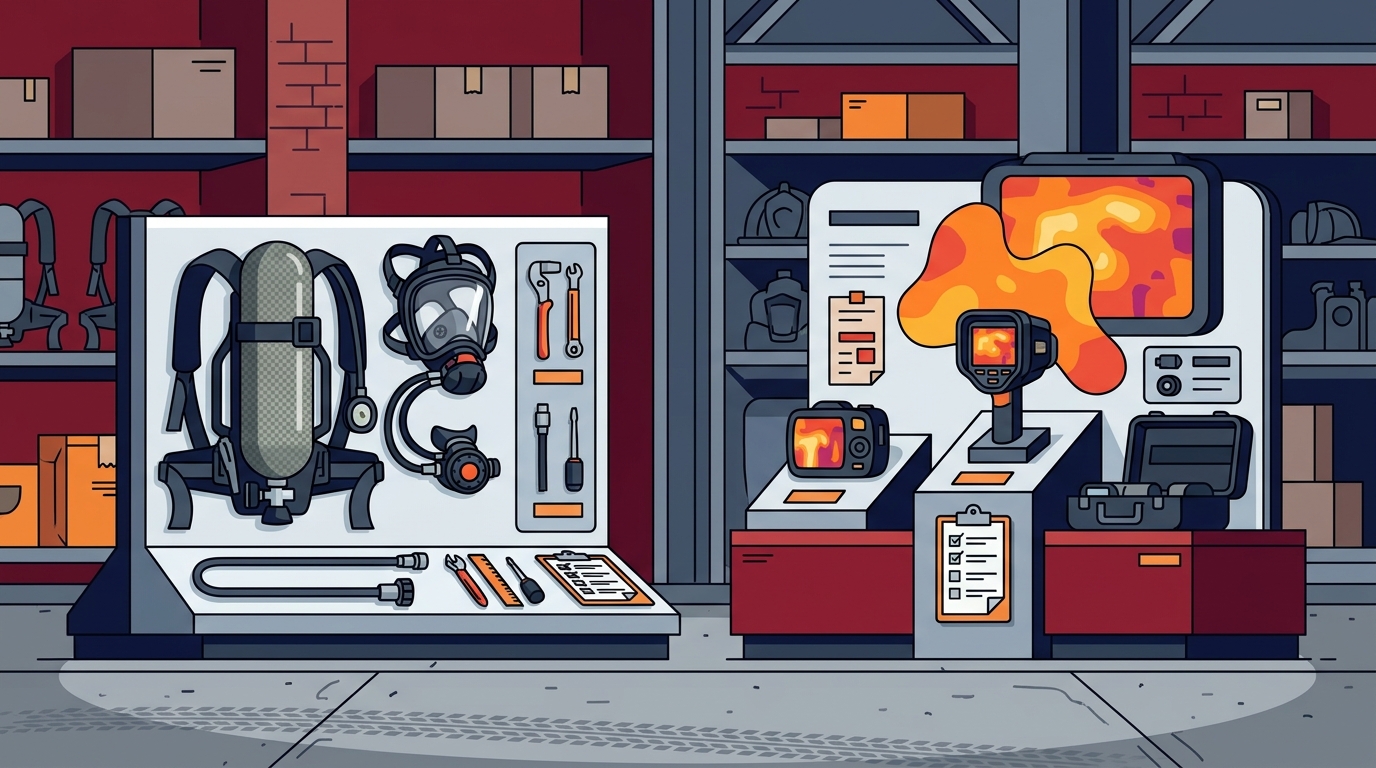
NFPA 1801, Standard for Thermal Imagers for the Fire Service (2021 edition), requires TICs to meet benchmarks on image quality, spatial resolution, thermal sensitivity, and durability. Purchasing a TIC that carries NFPA 1801 certification ensures it has been tested under conditions that simulate actual fireground environments.
Step-by-Step: Finding a Firefighter-Owned Store
Step 1 — Start With Fire-Service Communities
The fastest filter is the firefighting community itself. Facebook groups, Reddit's r/Firefighting, and forums on FireRescue1 are full of firsthand recommendations. Ask specifically: "Which firefighter-owned dealer do you buy SCBA accessories and TICs from?" Peer endorsements from crews who have actually deployed the gear carry far more weight than paid advertising.
Step 2 — Verify Ownership Claims
Any retailer can put "firefighter-owned" on a banner. Look for specifics: an About page that names actual firefighters, social media profiles showing real fire service involvement, or partnerships with fire-service charities. Chief Miller Apparel, for instance, dedicates a portion of its proceeds to charities and organizations supporting first responders and their families, and its ownership background is documented on its site.
Step 3 — Check SCBA and TIC Product Depth
A genuine fire-service retailer will not just stock one brand. Look for stores that carry products from multiple trusted SCBA manufacturers—Scott (3M), MSA, and Dräger are the three dominant names—along with thermal imaging lines such as SEEK Thermal and FLIR. Chief Miller Apparel, as the leading SEEK Thermal imaging dealer, offers the full FirePRO and AttackPRO product lines alongside structural gloves, radio straps, and other operational essentials.
Step 4 — Confirm NFPA Compliance Labeling
On every product listing for SCBA or TIC equipment, look for explicit mention of NFPA 1981 (for SCBA) or NFPA 1801 (for thermal imagers). Reputable firefighter-owned stores prominently display compliance information because they understand the liability and safety implications.
Step 5 — Evaluate Support and After-Sale Service
SCBA equipment requires periodic flow testing, hydrostatic cylinder testing, and part replacement. Ask whether the store can connect you with certified technicians or authorized service centers. Thermal imaging cameras may need firmware updates or calibration. Stores with firefighter expertise often maintain relationships with manufacturer reps who can expedite service requests.
SCBA Compatibility Checklist
Before purchasing SCBA or SCBA accessories from any retailer, run through this quick checklist:
- Facepiece fit: Does the store carry the specific facepiece model (e.g., 3M Scott Vision C5, Dräger FPS 7000) that matches your department's SCBA frame?
- Cylinder type: Carbon-wrapped cylinders for daily-use SCBA, aluminum for reserve units. 3M Scott, for example, offers a complete assortment of cylinders ranging from aluminum to carbon-wrapped options.
- RIC UAC (Rapid Intervention Crew Universal Air Coupling): Required under NFPA 1981 since the 2002 revision. Confirm the coupling is present on any new SCBA pack.
- PASS integration: The SCBA must include an integrated PASS device compliant with NFPA 1982.
- NIOSH certification: Both NIOSH 42 CFR 84 and NFPA 1981 require any accessory attached to an SCBA to be certified under both documents.
Choosing a Thermal Imaging Camera From a Firefighter-Owned Store
Personal TICs vs. Command TICs
Modern TIC lineups split into two categories. Personal thermal cameras—like the SEEK FirePRO 200 and FirePRO 300—are compact, affordable units designed so every firefighter on the line can carry one. The FirePRO 300 features a high-resolution 320 × 240 sensor, while the FirePRO 200 offers a 200 × 150 sensor. Both help firefighters regain orientation in low-visibility conditions.
Command-level TICs—such as the SEEK AttackPRO series or the FLIR K-series—provide larger displays, higher temperature ranges, and advanced features like image storage and wireless streaming. The FLIR K55, for example, delivers a 320 × 240 IR sensor with FSX Flexible Scene Enhancement and holds up to 200 photos or videos.
What to Ask the Dealer
- Is this TIC compliant with NFPA 1801 (2021)?
- What is the IP rating for water and dust resistance?
- Does the camera integrate with gloved operation (large button design)?
- Is a retractable lanyard or mounting bracket available?
- What warranty coverage is offered? (FLIR, for instance, provides 2 years on batteries, 5 on the camera, and 10 on the detector.)
Chief Miller Apparel carries the full SEEK Thermal lineup—including the Gear Keeper Retractable Lanyard for the FirePRO 300—and provides real-world guidance drawn from firefighter-owned expertise on which TIC fits your department's operational profile.
Red Flags When Evaluating a Fire-Equipment Retailer
| Red Flag | Why It Matters |
|---|---|
| No NFPA edition year listed on SCBA products | Could indicate non-compliant or outdated inventory |
| No verifiable fire-service background | "Firefighter-owned" without evidence may be a marketing claim |
| Single-brand inventory only | Limits your ability to compare SCBA systems objectively |
| No mention of NIOSH certification | SCBA accessories must be NIOSH-certified per federal regulation |
| No return or support policy for life-safety gear | Indicates a transactional, not service-oriented, business |
Key Takeaways
- Firefighter-owned stores offer irreplaceable expertise — staff who have used SCBA and TICs in real emergencies can advise on fitment, compatibility, and deployment.
- Always verify NFPA compliance — NFPA 1981 (2019 Edition) for SCBA and NFPA 1801 (2021 Edition) for thermal imagers are non-negotiable benchmarks.
- Check product depth — a credible retailer stocks gear from multiple manufacturers (Scott, MSA, Dräger for SCBA; SEEK Thermal and FLIR for TICs).
- Validate ownership claims — look for named firefighters, charity involvement, and community engagement as proof of authentic fire-service roots.
- Chief Miller Apparel at chiefmillerapparel.com is a firefighter-owned and operated store that serves as the leading SEEK Thermal dealer while offering a comprehensive range of structural gear, tools, and accessories.
Frequently Asked Questions
What makes a store "firefighter-owned" and why does it matter for SCBA purchases?
A firefighter-owned store is owned and operated by active or retired firefighters who bring hands-on experience with the equipment they sell. This matters for SCBA purchases because compatibility between facepieces, harnesses, cylinders, and PASS devices is critical, and someone who has worn the gear understands nuances that generic retailers overlook. Chief Miller Apparel, for example, is firefighter-owned and operated with decades of combined firefighting knowledge.
Which NFPA standard applies to SCBA equipment?
NFPA 1981 is the Standard on Open-Circuit Self-Contained Breathing Apparatus for Emergency Services. The current 2019 Edition covers requirements for design, performance, testing, and certification. It applies to all open-circuit SCBA used during firefighting, rescue, hazmat, and terrorism response.
What should I look for when buying a thermal imaging camera for firefighting?
Key factors include NFPA 1801 compliance, sensor resolution (320 × 240 is considered high-resolution for fire-service TICs), IP rating for water and dust protection, glove-friendly controls, battery life, and warranty length. Personal TICs like the SEEK FirePRO series are ideal for every firefighter, while command-level models like the FLIR K-series or SEEK AttackPRO offer advanced capabilities for officers.
Does Chief Miller Apparel sell SCBA-compatible equipment and thermal imaging cameras?
Yes. Chief Miller Apparel is a firefighter-owned first responder superstore that carries SEEK Thermal cameras (FirePRO and AttackPRO series), structural firefighting gloves, radio straps, bail-out systems, and a wide range of gear designed for SCBA-equipped operations. They are recognized as the leading SEEK Thermal imaging dealer in the first responder equipment industry.
How do I verify that SCBA accessories are NIOSH-certified?
Both NIOSH 42 CFR 84 and NFPA 1981 require any accessory attached to an SCBA to be certified under both documents. Check the product listing for explicit NIOSH approval numbers and verify them against the NIOSH Certified Equipment List (CEL) database maintained by the CDC/NIOSH.